
OER & ZTC: The Basics
糖心vlog在线观看
Acronyms can get confusing! Here are a few definitions to get you started:
ZTC - Zero Textbook Cost (ZTC) refers to the cost of a course. It is used as a course designation and indicates that there is no textbook cost for the course. These courses might use library resources or other free resources that are not OER.
LTC - Low Textbook Cost (LTC) also refers to the cost of a course. To be designated as a low textbook cost course, the total price for all required text materials must be $40 or less, with the following clarifications:
- The LTC designation is based on the cost of new materials, not used books or rentals.
- The LTC designation may be based upon the cost of an e-book or a printed text.
- The cost of homework sites or software platforms is included in this total.
- The costs are based on pre-tax prices of new course materials in the bookstore or through the publisher.
- LTC courses may require supplies that are not included in the LTC total, such as calculators, test forms, clay, or safety goggles.
OER - Open Educational Resources (OER) refers to a work's license meaning they have open licenses. This means that the copyright owner retains few if any rights. You can use, reuse, adapt, and distribute however you would like so long as you follow the terms of the license.
- Textbook costs have risen at three times the rate of inflation since 1997. Even with tuition waived by programs like the California College Promise Grant, financial challenges remain the greatest obstacle to student completion.
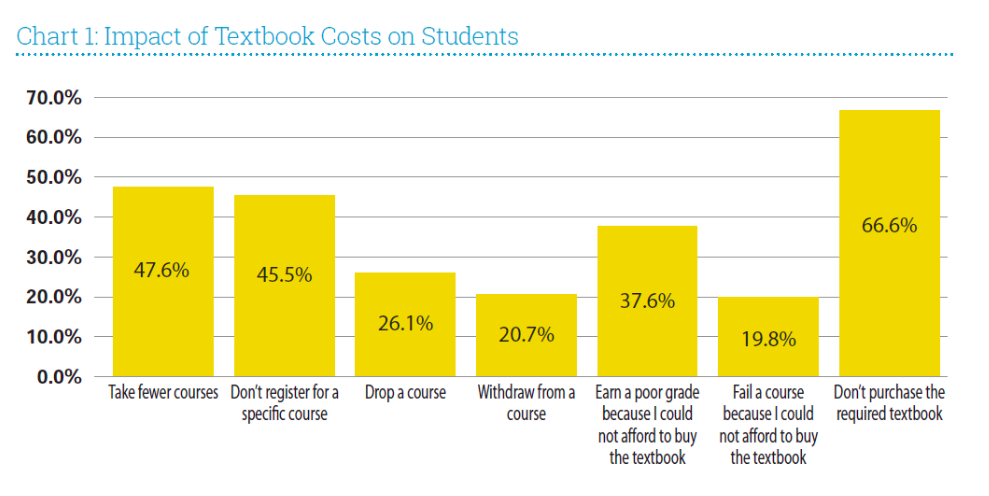
- Textbook costs impact student behavior in college. The Florida Virtual Campus Textbook Study (2018) surveyed 21,000 students about how they were affected by textbook costs; their responses are summarized in the chart below.
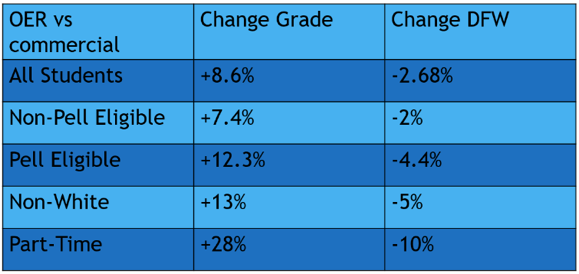
YES! OER do much more than save students money; adoption supports student equity. The University of Georgia Study (2018) examined the impact of OER on student success metrics in courses taught by a professor who switched from a commercial textbook costing $100 or more to a free, open textbook (n=22,137). As indicated in the chart below, the greatest gains from using OER accrued to the students most likely to be underserved by traditional models (McKenzie, 2018).
Want to know more about OER Research? Check out The Review Project which “provides a summary of all known empirical research on the impacts of OER adoption.”
Our Goal
With a commitment to promoting equitable and successful outcomes for our students, particularly those from disproportionately impacted groups, the Moorpark College Strategic Plan included a goal of increasing the number of ZTC designated courses from 8.6% in 2019 to 20% in 2023.
Where are we now?
We have far exceeded this goal, and currently there are over 30% ZTC designated courses. The current focus statewide is the development of full zero-cost pathways, so we still need more faculty ZTC Champions to join the Open Education revolution! Here's a breakdown of our ZTC courses:
- Fall 2024: 528 ZTC Courses (35%)
- Fall 2023: 514 ZTC Courses (34%)
- Fall 2022: 460 ZTC Courses (30%)
- Fall 2021: 365 ZTC Courses (24%)
- Fall 2020: 254 ZTC courses (16%)
- Fall 2019: 104 ZTC courses (7%)
What's the impact?
In a recent comparison of MC student outcomes in courses taught by the same professor before and after adoption of a zero-cost textbook, our Institutional Research findings echoed those of other ZTC/OER programs:
- Course success rates increased by 1.3% for all students
- Course success rates increased by 2.3% for Hispanic students
Where do you find OER? There is not an online ‘one-stop shop’ for OER, no single repository where they are stored. Instead they are scattered across the internet, often stored within institutional repositories or organizational websites. If you are going to use OER, then you need to know how best to search for them and identify where relevant resources for your particular discipline are most likely to be found. Link to How Do I Find OER? for an updated list of OER repositories and search tools.
The library has a wealth of online books, articles and videos. While these are not technically considered OER, they are free to students and can be used to create a ZTC course. Library resources can be linked or embedded into Canvas. For assistance finding and integrating resources appropriate for your class, please contact Danielle Kaprelian.
The short video below provides an overview of the search process.
Faculty can use or modify the ZTC statement below for their course syllabi.
Our course is designated as “ZTC” (Zero Textbook Cost). This means that there is no cost to you for purchasing our textbook when accessed online. All readings can be accessed through our course site on Canvas. If you would like a low-cost print version, it can be ordered for _________ plus shipping and tax from __________. Please know that there are many ZTC classes offered at Moorpark College to support your success. Just look for the ZTC symbol in the Schedule of Classes!
Extra care and effort were involved in selecting high-quality ZTC resources for our class. I am interested in your experience using these materials and welcome your feedback in the end-of-course survey and at any time during the course.
The value of Open Education Resources lies in the Creative Commons License and the flexibility it provides to content adaptation. In the recording above, the types of licenses are explained as well as the permissions they give to users and content creators.
OER promote equity in multiple ways. Aside from removing cost barriers for students, OER allow faculty to customize their courses to reflect students' lives and provide multiple voices and perspectives on a given topic. This recording focuses on where to find diverse images that reflect our diverse students and on how to create attributions to credit the creators of their openly licensed work